



















ADVENDURE is the leading web portal in Greece about Mountain Running, Adventure, Endurance and other Mountain Sports



I have a particular sensitivity toward people who engage deeply with music - especially my beloved Pink Floyd - and who are also involved in outdoor sports. Something inside me almost automatically makes me want to go deeper, not only into their performance, but above all into the culture, the way of thinking, and the philosophy that shapes them.
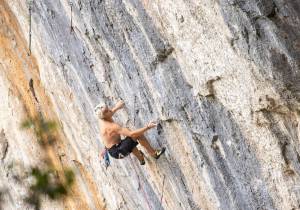
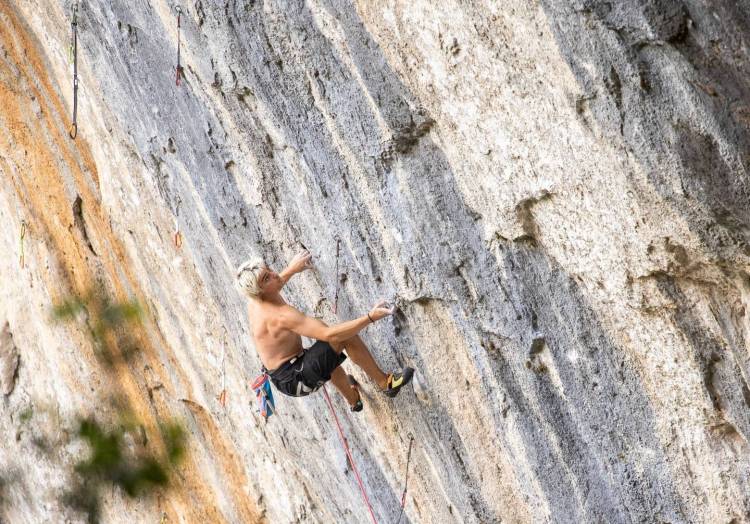
The case of Luca Andreozzi belongs exactly to this category. A climber with a strong creative and exploratory approach, he moves with ease between sport climbing, alpinism culture, skateboarding, and music, building a personal identity that escapes narrow labels. At 36 years old, Luca seems to approach climbing not only as a sport, but as a field of expression, self-awareness, and exploration — a way of reading the world and himself through the rock.
Within the framework of the “Set the Tone” event by Salewa Greece, in collaboration with the local outdoor store Wild Sport in Kalymnos, we had the opportunity to speak with Salewa's athlete about his return to the island after around 15 years, as well as about all those elements that compose his distinctive perspective on climbing and life.
We structured our conversation into thematic sections: from his experience in Kalymnos and its climbing culture, to his philosophy on performance, self-awareness, exploration, and the relationship between climbing, music, skateboarding, and alpinism.
The result is an in-depth interview with a person who, despite his relatively young age compared to the maturity of his thoughts, approaches the rock with a deeply existential dimension, as a “rock explorer”, as he chooses to define himself.


[Advendure]: Luca, you returned to Kalymnos after about 15 years as an official guest at Salewa Greece’s event “Set the Tone and Hike with Us,” in collaboration with the local outdoor shop Wild Sport. What was the first image or feeling that came to your mind when you saw the climbing crags of the island again, and how did you experience the event overall?
[Luca Andreozzi]: Returning to a climbing “Μecca” like Kalymnos is always a pleasure, especially because after 15 years you see things through different eyes. When I first came here, I was extremely focused on climbing routes and grades, and perhaps my perspective was somewhat limited to climbing itself, with everything else taking a back seat. This time, I wanted to enjoy all the different facets of the island. I wandered through the villages, tasted the local cuisine, and went for a few swims, trying to immerse myself as much as possible in the overall experience, beyond the context strictly related to climbing.

[Advendure]: Even though you had been climbing elsewhere over the years, you surely heard about developments on the island from fellow climbers and media. From your own experience and what you’ve learned, how has Kalymnos’ climbing culture evolved from then until today? Do you think the island still retains that “authentic” climbing feeling that made it stand out globally?
[Luca Andreozzi]: I believe the island has adapted extremely well to the growth of climbing over the past 15–20 years while preserving its charm and authenticity. It is undoubtedly one of the destinations that welcomes the largest number of climbers in the world, something that is evident from the wide range of services specifically designed for climbers, from accommodation facilities and guiding services to even aerial photography services. Paradoxically, I think the tremendous work that has gone into developing new climbing areas and crags has helped preserve the island’s authenticity. Although Kalymnos has become a mainstream destination, climbers still have the opportunity to spread out across different parts of the island, which helps reduce the feeling of overcrowding at the crags. At least, that was my impression during these past few days.

[Advendure]: Is there a particular route in Kalymnos that is deeply etched in your memory? One you would like to climb again when you return to the island?
[Luca Andreozzi]: I remember that the first time I came here, there was a saying: “You can’t say you’ve climbed in Kalymnos without climbing in the Grande Grotta.” I have great memories of climbing DNA, probably the most iconic route on the island, and just to its right, Priapos and Super Priapos, where I achieved my first onsight 8a. I also have very fond memories of the Secret Garden sector, although I don’t recall any specific route names there, as I was mainly climbing onsight.
[Advendure]: On social media you often use the motto “Rocks Explorer.” What does this term truly mean to you? Do you feel more like an athlete, a climber, or a “rocks explorer”?
[Luca Andreozzi]: I have always been deeply fascinated by the creative aspect of climbing, from the search for movement to the places where it is practiced. I have always enjoyed exploring, discovering, and developing new areas, and over the years this has been the element that has kept the flame of enthusiasm for this discipline alive. When climbing actually became my job as well, I somewhat struggled with the label of “athlete” or “pro climber”. Now that climbing has become an Olympic sport, I felt inconsistent defining myself that way among so many athletes who are stronger than me in terms of pure performance. Moreover, I felt that the most meaningful part of what defines me as a climber was being completely excluded from that definition. I asked myself what I truly was, and I came to the conclusion that “Rocks Explorer” better reflects this vision. It allows me to draw not only from the athletic side of climbing, but also from the more artistic one, where vision and movement merge to give life to something new and unexpected.
[Advendure]: For you, is climbing more about performance and results, or a path to self-awareness?
[Luca Andreozzi]: Performance and results are certainly an aspect of climbing, but I believe that climbing is, first and foremost, a challenge with oneself at any level. Personally, I think setting goals is definitely useful to trigger something within me, but the real challenge is the inner process that leads to the achievement of those goals — moving from desire to insecurity, and then to new levels of awareness that, in some way, make you different from how you were at the beginning of the process, and better. Climbing has always given me a great deal in this respect.

[Advendure]: In a previous interview, you said that the rock works as a “mirror” for you. What have you learned about yourself through climbing?
[Luca Andreozzi]: Yes, I think that, much like in front of a mirror, climbing confronts you with your deepest insecurities with every slightly more distant hold. Personally, what I have learned from climbing and have been able to apply to everyday life is the ability to maintain clarity and control in the face of the unexpected. When you are climbing and suddenly realize you don’t know how to continue, it is very easy for the mind to focus on the problems, leading you into panic and amplifying fears and insecurities even further — a dynamic that is completely unhelpful in solving the situation. In these moments, it is essential to regain control over your emotions and channel them toward a practical solution that allows you to overcome the obstacle quickly, without wasting mental energy.
[Advendure]: You come from a more urban climbing culture, influenced by skateboarding and indie rock, if we also include your musical influences. How do you see the relationship between this culture and more traditional alpinism?
[Luca Andreozzi]: I believe that independent music and skateboarding culture actually share far more common ground with the world of alpinism than one might think. In the 1970s, climbing was exploding in Yosemite Valley at the same time as skateboarding in Santa Monica and the rise of independent punk rock movements. At that time, these were still very niche subcultures, but in their origins they were all disruptive activities, forms of rebellion against the system and in contrast with the dominant social standards of the time. Looking at how these disciplines have evolved over the years, and how we are now used to seeing them mainly as sports within the Olympic Games and official competitions, it is easy to forget the punk origins of these movements. We tend to perceive them as completely separate and distant worlds, but I like to remember their closeness in my own approach to climbing today.
I try to constantly explore new ways of blending different disciplines and styles, also by breaking down schemas and barriers between them, especially with traditional alpinism, which I enjoy “urbanizing” by bringing a bit of that street culture typical of skateboarding even into the snowy peaks of the Dolomites.
[Advendure]: The project “The NXT Step” showed exactly this bridge between two different worlds. Tell us a few words about it, and what you took away most from your collaboration with Hanspeter Eisendle.
[Luca Andreozzi]: “Next Step” was born from the desire of both Salewa and myself to break down the boundaries between the world of “street” climbing and traditional alpinism. I was given the opportunity to climb alongside a true alpinism legend, Hanspeter Eisendle, in the fantastic setting of the Dolomites — a place I had never experienced before that moment.
What you see in the video is entirely “take one”, with no filters and no acting, and I think it expresses very well the harmony and balance that developed between Hans and me, despite the age difference and the very different backgrounds we come from, highlighting a true “generational encounter”.
I discovered in Hans the same passion and curiosity for rock that I have — an interest that transcends everything else and finds its most natural expression on the rock itself.

[Advendure]: Do you think anything is missing from today’s new generation of climbers? And if we reverse the question, what can older generations learn from younger climbers?
[Luca Andreozzi]: It is very clear that today we have somewhat lost that spark of adventure that was an essential part of climbing in its origins. In a globalized and digitalized world, information and communication seem to move so quickly that they almost completely erase the sense of wonder and amazement, making everything convenient and accessible, but at the same time cold and “soulless”.
Among the new generations of climbers, I notice an increasing lack of interest in the history of climbing, its places, and its characters, leading to a more detached approach where people tend to stay only at the surface of things. A very clear example is that almost no one refers to routes by their names anymore, but only by their difficulty grades, thus erasing part of the history that led to the creation of the route itself, and also the story of the route setter.
At the same time, it is fascinating to see how young people have managed to spread interest in this sport through new forms of communication, bringing it to a peak of popularity never reached before. I think it will be interesting (and necessary) in the future to find a balance between these two worlds, if we want to preserve memory while also continuing to move forward.
[Advendure]: What does it mean to you to “set the tone” in the mountains and in life?
[Luca Andreozzi]: For me, “Set the Tone” means remembering to listen to yourself and to be able to find your own rhythm again. In the mountains, as in life, it is easy to be diverted from your path and end up inside loops that do not belong to you, perhaps “tricked” by your ego or by comparison with others, gradually losing contact with the raw reality and the joy of simply being there.
More than once, while trying a difficult route, I have found myself inside a process of frustration and stopped to ask myself who I was actually doing it for — whether I was still enjoying it, or whether I was acting only out of a sense of duty towards myself or towards the expectations of others.
For me, “Set the Tone” is that moment when I stop and look inward, to understand whether I am still following my inner tone or whether, without even realizing it, I am following someone else’s.

[Advendure]: Climbing became an Olympic sport at the Tokyo Olympics. How do you see this transition? Do you think the Olympic dimension helps climbing evolve, or is there a risk of losing part of its authentic culture? This is a topic that concerns us a lot as well, in relation to trail running and its potential inclusion in the Olympic Games in the future.
[Luca Andreozzi]: The inclusion of climbing in the Olympic Games has certainly been a historic opportunity to introduce this discipline to the world and contribute to its evolution. At the same time, however, placing a sport within the Olympic framework inevitably implies a certain degree of structuring — a series of technical measures aimed at standardization — which progressively reduces the space for creativity and the expressive character of the discipline itself.
This “encapsulation” has made competitive indoor climbing almost a discipline in its own right, with athletes training exclusively for competitions without ever feeling the need to climb real rock, and vice versa. The gap between the indoor and outdoor worlds has grown significantly since the Tokyo Olympics.
Exactly the same thing is happening in skateboarding as well, with a growing divide between new generations of athletes and the older ones. I believe that in the coming years, in both cases, it will be necessary to find a balance between these two worlds and these generations, which have now become quite distant from one another.
[Advendure]: Do you think sport climbing and traditional outdoor climbing are drifting further apart, or do they continue to influence each other?
[Luca Andreozzi]: I believe that traditional climbing and sport climbing have been feeding into each other very well in recent years, as many sport climbers have transferred their skills into trad climbing, using removable protection.
Just last year, the hardest trad route in the world was established, graded at around 9a in sport climbing terms. The same is happening in alpinism, with the establishment of high-altitude multipitch routes graded up to 8C.
I think this evolution is very interesting.

[Advendure]: If a young athlete starts today exclusively in gyms and competition walls, what would you tell them about the importance of connecting with real rock?
[Luca Andreozzi]: I see every day children and young people starting to climb in my gym, and I often notice that parents enroll them in a sport with the goal of turning them into great champions, as if practicing sport were solely aimed at producing champions and medals, rather than simple enjoyment.
I simply remind them to have fun. With the younger kids, I mix play and climbing, and with the older ones I create group exercises that also stimulate a sense of community and social interaction.
To young athletes, instead, I say not to take themselves too seriously — that climbing can be much more than a sporting result, and that they should remain open to the possibilities this discipline offers beyond pure performance, trying to transmit a bit of that passion and connection with the rock and nature that I still feel so strongly when I climb, even after 30 years.
[Advendure]: In the “The NXT Step” project, it seemed that your biggest challenge was not the climbing moves themselves, but the alpine environment and exposure. How did that experience affect or change you?
[Luca Andreozzi]: The experience in the Dolomites during Next Step was very intense, and the surrounding environment challenged me more than I had expected. I remember that while climbing and approaching the crux pitch, Hans warned me about the exposure and the height we would have beneath us.
I have always climbed with confidence at height, but I have to say that the void really surprised me. In addition, we had to deal with the weather conditions, even facing a snowstorm on the way back while walking on ice and snow, and we had to maintain a high level of concentration even once we reached the summit, because at those altitudes the descent can often prove very difficult and dangerous — something I had never really taken into consideration when climbing at sport crags.
[Advendure]: What does “fast and light” in the mountains mean to you?
[Luca Andreozzi]: For me, “fast and light” means being able to move in the mountains with the same agility and freedom of movement you experience on the ground. Coming from the world of sport climbing and skateboarding, I feared that the alpine environment would greatly limit my movement due to heavy technical gear, but I have to say that Salewa’s NXT line has fully succeeded in achieving this goal.
[Advendure]: Do you see yourself moving more towards alpinism in the future?
[Luca Andreozzi]: I don’t rule it out at all — on the contrary, I think I will really enjoy it! I am fully aware that I won’t be able to maintain the same level of difficulty over time, and I have always chosen to keep alpinism for the future, both for physical reasons but also as a way to renew my enthusiasm. I find it very comforting to know that in the future I will have an entire world to rediscover, with new destinations and new horizons to explore.

[Advendure]: Is there a project or region in the world where you imagine your next major climbing experience taking place?
[Luca Andreozzi]: I have never had grand visions of the future; I prefer to be guided by instinct in the present. But I definitely see myself discovering and equipping new climbing areas close to home — sometimes climbing them myself, sometimes leaving them in the hands of future generations — continuing to contribute to the development and growth of climbing, but in a different way than I do now.
[Advendure]: You started climbing at just 6 years old. How did this early connection with rock come about, and what do you remember most vividly from those first experiences?
[Luca Andreozzi]: When I was a child, I started climbing in a completely natural way: I loved climbing trees, the walls of my house, and the school walls. My father used to practice climbing before I was born, so I knew this activity existed, even though I didn’t really know what climbing was. I only knew that I liked being up high and that I felt this call.
So I asked him to take me to try it. I vividly remember the first time I touched the rock: it was like a lightning strike of love, a sense of belonging. I felt I had found my place, and I knew I would never stop doing it for my entire life.
Thirty years have passed since that day, and I still feel that I belong to the rock, as if I were entering a different world every time I move on a wall — a world I know well and of which I feel part.

[Advendure]: From our conversations in Kalymnos, I remember that you love music. What kind of music do you usually listen to before a hard climb?
[Luca Andreozzi]: I have a very visceral relationship with music. I started as a child with Pink Floyd records and then continued exploring different artists and genres, sometimes becoming interested in the lives of the musicians I was listening to, who greatly influenced my style. I have listened to everything — from punk to jazz — and in my collection coexist very different artists, from Radiohead to Keith Jarrett, from David Bowie to John Coltrane, and Massive Attack. Before a difficult climb, I choose Fugazi!

[Advendure]: Skateboarding and climbing: what common traits do you see between the two?
[Luca Andreozzi]: I believe that skateboarding and climbing have a lot in common because both disciplines allow you to “reinterpret” reality: through the idea of a trick or the vision of a sequence, you can create movement where nothing existed before.
The execution of a climbing sequence or a skate trick is directly proportional to the ability to imagine it in the first place, thus transforming the gesture into a true form of expression and giving life to a unique language, in which both disciplines come closer to an art form than to a sport.
This is what I love about both disciplines, and sometimes I have the feeling that I am doing the same thing, just with different languages.
Dimitrios Troupis

Κατάγεται από το Ξυλόκαστρο Κορινθίας και ζει μόνιμα στην Πάτρα. Συμμετείχε στην συντακτική ομάδα του Adventure Zone από το 2009, ενώ μαζί με τον Τάκη Τσογκαράκη ίδρυσαν και "τρέχουν" το Advendure. Το τρέξιμο στα μονοπάτια των βουνών και η μεταφορά εικόνων και συναισθημάτων μέσα από τα άρθρα του αποτελεί αναπόσπαστο κομμάτι της ζωής του. Παθιάζεται με τους αγώνες ορεινού τρεξίματος, υπεραντοχής και περιπέτειας. Έχει πολλές συμμετοχές και διακρίσεις σε αγώνες ορεινού τρεξίματος όλων των αποστάσεων, με έμφαση στους αγώνες ultra trail. Θεωρεί ότι το τρέξιμο και η πεζοπορία στη φύση είναι μια εσωτερική ανάγκη του ανθρώπου, μας φέρνει πιο κοντά σε αυτήν και μας κάνει να αγαπήσουμε περισσότερο το περιβάλλον.
Συνέντευξη στην ET1:
https://www.youtube.com/watch?v=3iyn3QmFlyE
Podcast "Γιατί Τρέχουμε" - s2 #09"
https://www.youtube.com/watch?v=2LTrKZ8PyWc
www.advendure.com




ADVENDURE is the leading web portal in Greece about Mountain Running, Adventure, Endurance and other Mountain Sports